

 ES
ES  EN
EN  FR
FR 
Chez SOTECMA, des équipements expérimentaux et des prototypes seront développés pour tester des additifs complexes, afin d’apporter des solutions aux incertitudes liées à leur fabrication.
Handling of Specialty Mortars
Today there is a wide variety of specialty mortars, covering as many formulations as there are additives and application requirements. These include coloured monocouche mortars, tile adhesive mortars, expansive mortars, self-levelling mortars, high-temperature mortars and many other specific formulations.
The main challenge lies in handling the different additives used in these mixtures, as their physical and chemical properties can vary considerably from one material to another.
For example, the behaviour of a fibre such as rock wool is completely different from that of a pigment such as iron oxide when it comes to storage, extraction from the storage area and transportation to the production process.
However, it is common practice to manufacture a wide range of these mortars in the same plant using the same equipment, without properly considering the specific handling requirements of each product.
This creates the need to develop new processes, equipment and installations capable of handling each of these components correctly.
At present, in many specialty mixtures containing materials with complex handling characteristics, dosing is still carried out manually. This exposes operators to handling risks and makes it difficult to ensure consistent quality and uniform mortar homogeneity over time.
For this reason, it is essential to develop new components for conveying, dosing and mixing equipment capable of automating these operations and eliminating manual handling.
Most additives can be dosed using screw feeder systems. However, conventional commercial feeders and agitators generally do not provide suitable extraction and mixing for these types of materials.
The design of the agitator blades, together with the type and geometry of the screw flight, are key factors in achieving a continuous and uniform product flow. This is particularly important because, in continuous dosing processes, any interruption in material feeding directly affects the quality of the final mixture.
The main problems associated with these additives, which also create processing difficulties, are as follows:
- High cohesiveness.
- Hygroscopicity.
- Deliquescence.
- Chemical decomposition due to moisture or temperature.
- Fibre breakage caused by friction.
- Fibre entanglement.
- Particle breakage.
- Arching inside hoppers and silos.
- Formation of ratholes or internal flow channels in hoppers and silos.
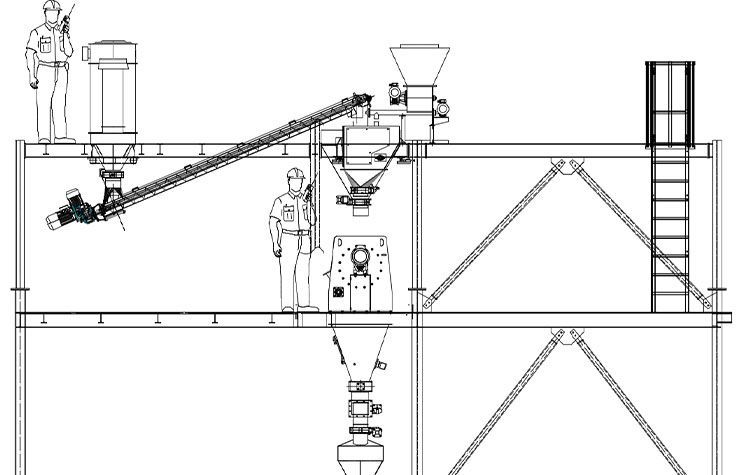
The use of these materials presents significant technical challenges for manufacturers of conventional machinery and equipment, as it requires the dosing and mixing of components with widely different bulk densities.
This is particularly the case with lightweight mortars, where the main components have densities ranging from 100 to 150 kg/m³, while certain additives may reach densities of up to 1,500 kg/m³. In addition to this density difference, there is also a considerable imbalance in the proportions of each component used.
In some formulations, as little as 1 kg of additive is dosed for every 10,000 kg of the main component.
This results in an especially complex mixture requiring the specific development of both process parameters and key plant components, including mixer paddle design, machine rotational speed and mixing time, among other factors.
Development of Experimental Equipment
Within this context, SOTECMA identified the need to develop a dosing, conveying and application process capable of providing the optimum conditions for the product to achieve its full performance throughout its service life.
Formulation development is a fundamental part of the project. However, the experimental phase is equally essential, as new processes and components specifically adapted to these applications must be developed.
To achieve this, SOTECMA will design and manufacture equipment intended exclusively for experimental purposes, providing the working conditions required for the research and validation of new solutions.
This testing equipment will consist of a demonstration prototype designed for experimentation with additives exhibiting complex handling behaviour, specifically developed to address the uncertainties associated with the many variables involved in the production of specialty mixtures containing additives.